
V-Belt Sizes Explained: A, B, C Sections, SPA and SPB Wedge Belts
What the letters and numbers on a V-belt mean, how classical and wedge belts differ, how to measure an old belt when the print has worn off, and how to fit and tension a new one so it lasts.
The short answer
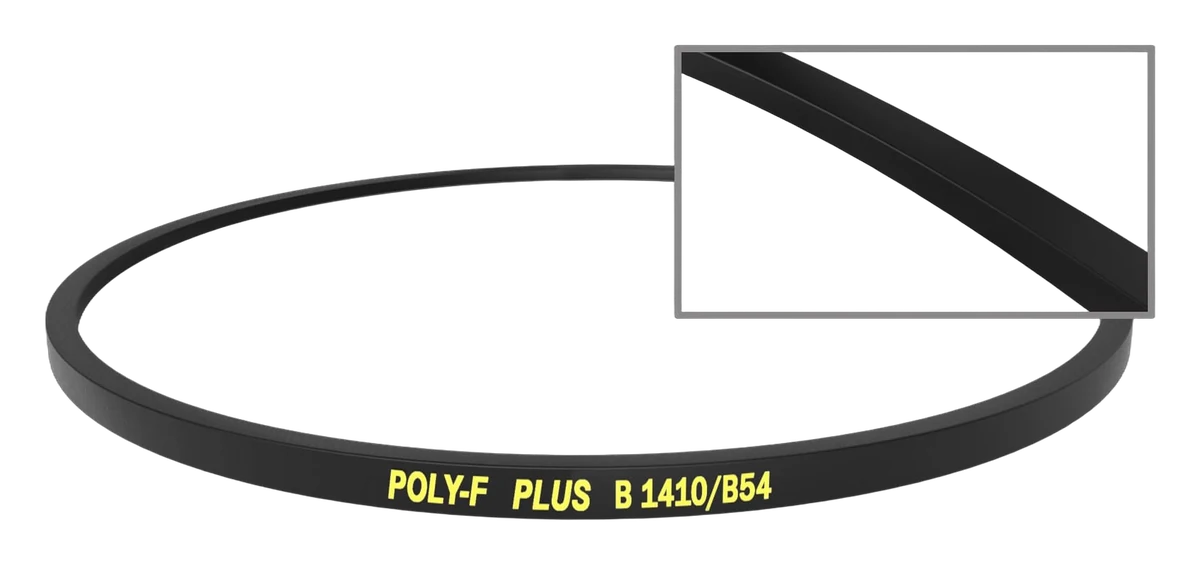
A V-belt is identified by two things: its section (the shape and size of its cross-section, given by a letter such as A, B or SPA) and its length. The size printed on the back of the belt gives both. For example:
B54is a classical B section belt with a 54 inch inside length.SPA 1250is an SPA wedge belt with a 1250 mm datum length.
If the print has worn off, measure the top width and the height of the belt to find the section, and measure its length as described below. The section must match the pulley grooves; the length must suit the distance between the shafts.
Classical and wedge belts: two families
Industrial V-belts come in two main families:
- Classical V-belts (sections Z, A, B, C, D and E) are the older, general-purpose design, still used on most motors, pumps, compressors and machine tools.
- Narrow or wedge V-belts (sections SPZ, SPA, SPB and SPC) are deeper for their width. The extra depth lets them carry more power in the same width, so a wedge belt drive needs fewer belts or narrower pulleys for the same job.
Both families are covered by ISO 4184, which lists classical sections Y, Z, A, B, C, D and E, and narrow sections SPZ, SPA, SPB and SPC.
V-belt section size chart
Measure the top width (across the widest face) and the height (thickness) of the belt with a vernier caliper and compare with this table. Dimensions are nominal, in millimetres; makers' figures vary slightly.
| Section | Top width | Height | Typical uses |
|---|---|---|---|
| Z | 10 | 6 | Small motors, light machines |
| A | 13 | 8 | Pumps, fans, small machine drives |
| B | 17 | 11 | The most common industrial section |
| C | 22 | 14 | Larger motors, compressors, crushers |
| D | 32 | 19 | Heavy drives |
| E | 38 | about 23 to 25* | Very heavy drives |
*The height of E section belts differs between makers; go by the top width and the maker's catalogue.
| Section | Top width | Height | Marked with |
|---|---|---|---|
| SPZ | 9.7 | 8 | Datum length in mm |
| SPA | 12.7 | 10 | Datum length in mm |
| SPB | 16.3 | 13 | Datum length in mm |
| SPC | 22 | 18 | Datum length in mm |
The quickest test: a wedge belt is noticeably taller for its width than a classical belt. An A belt (13 × 8) and an SPA belt (12.7 × 10) have almost the same top width, but the SPA is 2 mm deeper.
How to read the numbers on a V-belt
Classical belts: inside length in inches
In India, classical belts are usually ordered by section letter and inside length in inches: A42, B54, C120. The inside length is the length round the narrowest, inner face of the belt. Many makers also print other lengths beside it, such as the datum (pitch) length in millimetres, because pulley calculations use the datum length.
Wedge belts: datum length in millimetres
Wedge belts are marked with the section and the datum length in millimetres: SPZ 1000, SPA 1250, SPB 2240. The datum length is measured at the belt's datum line, the line that runs at the pulley's datum (effective) diameter.
Other marks you may see
- Brand and range, for example Fenner Poly-F Plus.
- Raw edge or cogged marks, for example an X after the section on some cogged belts (AX, BX), showing a notched underside.
- Batch codes and dates, which do not affect the size.
Do not convert between length systems yourself. The difference between inside, datum and outside length depends on the section and on the maker. If you have only one length, give it to us with the section and we will match it from the maker's chart.
How to measure an old belt when the print has worn off
- Find the section. Measure the top width and height with a vernier caliper and match them to the tables above.
- Measure the length. Wrap a flexible measuring tape round the outside of the belt and note the outside length. Tell us it is the outside length; we will convert it.
- If the belt has broken or is missing, measure on the machine: run a string round both pulleys in the groove, at the depth the belt would sit, with the motor moved to the middle of its adjustment. Measure the string.
- Count the grooves on the pulley. A multi-groove drive needs that many belts, as a matched set.
Matching belts to pulleys
Each section needs its own groove profile. A belt in the wrong groove either sits too high, slipping and wearing its edges, or bottoms in the groove and loses its grip. When fitting new belts, check:
- The groove section. Pulleys are usually marked with their section (for example SPB or B) on the hub. Some pulleys are made to take either a classical or the matching wedge belt; if yours is not marked, ask us before mixing them.
- The groove condition. A worn groove has shiny, dished sides and lets the belt ride too deep. Run your finger down the groove wall: it should be straight. Worn pulleys eat new belts, so replace them.
- The pulley diameter. Every section has a minimum pulley diameter. Running a belt round a pulley that is too small bends it too sharply and shortens its life. Cogged (notched) belts bend more easily and suit smaller pulleys.
Multi-belt drives need matched sets
On a drive with two or more belts, all the belts must share the load equally. Belts of the same nominal size can differ very slightly in length, so a longer belt sits slack and does no work while the others are overloaded. Buy multi-belt drives as a matched set from one maker, and always replace every belt on the drive at the same time, even if only one has broken. Never mix old and new belts, or belts from different makers, on one drive.
Fitting and tensioning a V-belt
- Isolate the machine and lock off the power before you start.
- Slacken the motor on its slide rails or base so the belts can be fitted without force. Never lever a belt over the pulley rim with a screwdriver; it breaks the internal cords even if the belt looks fine.
- Check alignment. Lay a straight edge or string across both pulley faces. The pulleys should touch it at four points, and the shafts should be parallel.
- Tension the belts. A widely used rule is a deflection of about 16 mm for every metre of span (1/64" per inch) when you press the middle of the span with a moderate force. The belt makers publish the exact force for each section and pulley size; a belt tension gauge takes the guesswork out.
- Run and re-check. New belts seat into the grooves and stretch slightly in the first hours of running. Check and re-tension after about a day of work.
Too little tension makes belts slip, squeal and glaze; too much overloads the motor and pulley bearings and shortens belt life. A belt that squeals at start-up is usually slack.
Signs a V-belt needs replacing
- Cracks across the underside, especially when the belt is bent backwards.
- Shiny, glazed sides, a sign of slipping.
- Frayed or torn edges, often from misaligned pulleys.
- The belt sits low in the groove, almost touching the bottom (belt or pulley worn).
- Squealing that tensioning does not cure.
- Different belts in a set sagging by different amounts while running.
Classical, wedge or something else?
When fitting new belts to an existing drive, use the same type as before unless the drive is being redesigned. When designing a new drive, wedge belts usually give a more compact, efficient drive than classical belts. If the drive must keep exact timing between shafts, a V-belt is the wrong choice: use a timing belt or a roller chain, which cannot slip.
What to send us when you order
- The size printed on the old belt, for example
B54orSPB 1800, and the brand if you know it. - Or the section (top width and height) and the outside length you measured.
- The number of belts on the drive, so we can supply a matched set.
- A photo of the print on the back of the belt on WhatsApp.
We stock Fenner Poly-F Plus and PIX V-belts in classical and wedge sections, with taper lock and cast iron pulleys, at our shop on SP Road, Bengaluru.