
Roller Chain Sizes: How to Identify and Measure Any Roller Chain
Three measurements identify almost any roller chain. Here is how to take them, how to read British (08B) and American (ANSI 40) chain numbers, why they do not mix, and how to tell when a chain is worn out.
The short answer
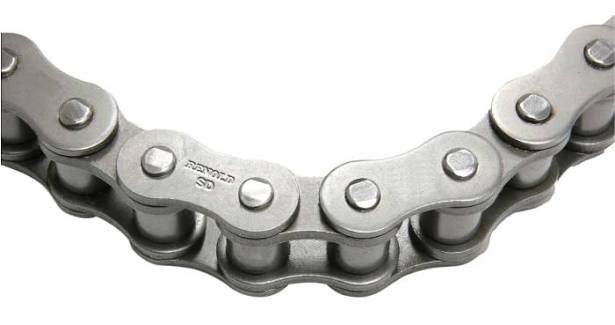
A roller chain is identified by three measurements: the pitch (the distance between pin centres), the roller diameter and the inner width (the gap between the inner plates, where the sprocket tooth sits). Add the number of strands (simplex, duplex or triplex) and whether the chain is to the British or the American standard, and you have the full chain size.
Most chains in Indian factories are one of two families:
- British Standard (ISO 606 B series), numbered like
08B-1,10B-2or12B-1. This is the most common family in India. - American Standard (ANSI B29.1, ISO 606 A series), numbered like
40,50-2or60. Common on imported machines, packaging lines and anything built in the USA or Japan.
The two families share some pitches but are not interchangeable. The rest of this guide shows how to tell them apart.
The three measurements that identify a chain
1. Pitch
Pitch is the distance from the centre of one pin to the centre of the next. It is the single most important number, because the chain must match the sprocket's pitch exactly. Roller chain pitches are based on inches: 3/8" (9.525 mm), 1/2" (12.7 mm), 5/8" (15.875 mm), 3/4" (19.05 mm), 1" (25.4 mm) and so on.
2. Roller diameter
The outside diameter of the rollers. This is where the British and American chains of the same pitch often differ, so measure it with a vernier caliper rather than by eye.
3. Inner width
The clear width between the two inner plates, which is the width of the roller. Measure it with the inside jaws of a vernier caliper. The sprocket tooth has to fit in this gap, so a chain that is too narrow will not sit on the sprocket, and one that is too wide will run sideways and wear quickly.
How to measure pitch accurately
Do not measure a single pitch. A 12.7 mm pitch and a 12.0 mm one look the same on a ruler, and a worn chain will already have stretched a little. Instead:
- Lay the chain flat on a bench and pull it straight so all the links are in tension.
- Measure from the centre of one pin to the centre of the pin ten pitches further along (count the gaps, not the pins).
- Divide by ten. A reading of about 127 mm over ten pitches means a 12.7 mm (1/2") pitch chain.
Pin centres are hard to find by eye, so a reliable trick is to measure from the leading edge of one pin to the leading edge of the pin ten pitches along. The distance is the same as centre to centre.
British and American chains: why they do not mix
An 08B British chain and an ANSI 40 American chain both have a 12.7 mm pitch, and people often assume they are the same. They are not. The 08B has a larger roller (8.51 mm against 7.92 mm) and a slightly narrower inner width (7.75 mm against 7.85 mm). Running one on sprockets cut for the other gives a poor fit on the teeth, faster wear and, on a duplex chain, a mismatch across the strands.
The strand spacing on multi-strand chains is also different. The transverse pitch (the distance between strands) of an 08B-2 duplex chain is 13.92 mm, while an ANSI 40-2 is 14.38 mm. A duplex chain from the wrong family will not sit on a duplex sprocket at all.
Rule of thumb: replace like with like. If the old chain is marked 08B, buy 08B, and if it is marked 40, buy 40. If it has no marking, measure the roller diameter: that is the quickest way to tell the two families apart.
How to read chain numbers
British Standard (ISO 606 B series)
The number before the B is the pitch in sixteenths of an inch. So 08B is 8/16" = 1/2" pitch, 10B is 10/16" = 5/8", 12B is 3/4" and 16B is 1". The number after the dash is the number of strands: 08B-1 is simplex, 08B-2 duplex and 08B-3 triplex.
American Standard (ANSI)
The first digit, or first two digits, give the pitch in eighths of an inch: 40 is 4/8" = 1/2", 50 is 5/8", 60 is 3/4", 80 is 1" and 100 is 1-1/4". The last digit tells you the type:
- 0: standard roller chain, for example
40,60. - 1: lightweight chain with narrower parts, for example
41, which is lighter than a40. - 5: rollerless (bush) chain, for example
35and25.
A dash and a number give the strands: 40-2 is duplex. A letter H after the number, as in 60H, means heavy series with thicker plates, which fits the same sprockets as the standard chain.
Roller chain size chart
Use these tables to identify a chain from your measurements. Dimensions are in millimetres: roller diameter is the maximum and inner width the minimum, as listed in the TI Diamond catalogue for its ISO 606 chains, so a new chain measures very close to these figures.
| Chain | Pitch | Roller dia. | Inner width | Typical uses |
|---|---|---|---|---|
| 05B | 8.00 | 5.00 | 3.00 | Light drives, small machines |
| 06B | 9.525 (3/8") | 6.35 | 5.72 | Light industrial drives |
| 08B | 12.70 (1/2") | 8.51 | 7.75 | The most common industrial size |
| 10B | 15.875 (5/8") | 10.16 | 9.65 | Conveyors, machine drives |
| 12B | 19.05 (3/4") | 12.07 | 11.68 | Heavier drives |
| 16B | 25.40 (1") | 15.88 | 17.02 | Heavy drives |
| 20B | 31.75 (1-1/4") | 19.05 | 19.56 | Heavy industry |
| 24B | 38.10 (1-1/2") | 25.40 | 25.40 | Heavy industry |
| Chain | Pitch | Roller dia. | Inner width | Notes |
|---|---|---|---|---|
| 25 | 6.35 (1/4") | 3.30* | 3.10 | *Rollerless: bush diameter |
| 35 | 9.525 (3/8") | 5.08* | 4.68 | *Rollerless: bush diameter |
| 40 | 12.70 (1/2") | 7.92 | 7.85 | Most common ANSI size |
| 41 | 12.70 (1/2") | 7.77 | 6.25 | Lightweight |
| 50 | 15.875 (5/8") | 10.16 | 9.40 | |
| 60 | 19.05 (3/4") | 11.91 | 12.58 | |
| 80 | 25.40 (1") | 15.88 | 15.75 | |
| 100 | 31.75 (1-1/4") | 19.05 | 18.90 | |
| 120 | 38.10 (1-1/2") | 22.23 | 25.25 |
Notice the pattern: at 5/8" and 1" pitch the two families are close, while at 1/2" and 3/4" they clearly differ (an 08B is 7.75 mm wide inside, an ANSI 40 is 7.85 mm; a 12B is 11.68 mm, an ANSI 60 is 12.58 mm). Always measure.
Simplex, duplex and triplex
A simplex chain has one row of rollers. A duplex chain has two rows joined by long pins, and a triplex three. Adding strands raises the power the drive can carry without moving to a larger pitch, which keeps the sprockets small. A duplex chain is roughly twice as strong as a simplex chain of the same size, but its power rating is a little under twice, because the load is not shared perfectly between strands; makers publish exact ratings in their catalogues.
A multi-strand chain needs a sprocket with the same number of rows of teeth, at the same transverse pitch. You cannot run a duplex chain on two simplex sprockets placed side by side.
Chain length, connecting links and offset links
Chain is sold by length (usually in 5 m boxes or by the metre) and cut to the number of pitches you need. A few points that save trouble:
- Count pitches, not centimetres. For a closed loop, the chain length must be a whole number of pitches. Give us the number of pitches (or the number of rollers, which is the same thing in a closed loop) and we will cut it exactly.
- Use an even number of pitches where you can. A chain with an even number of pitches joins with a standard connecting link (also called a joining link or master link), held by a spring clip on smaller chains or by split pins on larger ones.
- An odd number of pitches needs an offset link (also called a cranked link or half link). Offset links are weaker than the rest of the chain, so avoid them on heavily loaded drives: change the centre distance or a sprocket size instead if you can.
- Fit the spring clip the right way round. The closed end of the clip should face the direction the chain travels, so it cannot catch on anything and spring off.
Is your chain worn out? The elongation check
Chains do not really stretch; the pins and bushes wear, and each tiny bit of wear at every joint adds up to a longer chain. A worn chain rides up the sprocket teeth, runs noisily, skips under load and wears the sprockets.
To check wear, measure a length of chain under light tension and compare it with the nominal length:
- Pick a number of pitches, for example 20.
- Nominal length = number of pitches × pitch. For 20 pitches of 08B chain: 20 × 12.7 = 254 mm.
- Measure the actual length over those 20 pitches, edge of pin to edge of pin.
- Elongation (%) = (measured − nominal) ÷ nominal × 100.
Most chain makers give 3% elongation as the wear limit for general drives. For 20 pitches of 08B, that is a measured length of about 261.6 mm. Drives with large sprockets, or where timing matters, should be replaced sooner, often at 1.5 to 2%, because a large sprocket tolerates less wear before the chain starts to ride up the teeth. Check the chain maker's catalogue for your drive.
Change sprockets with the chain. A new chain on worn sprockets (teeth that look hooked or pointed, like a shark fin) wears out quickly. If the drive has run until the chain was badly worn, replace the sprockets too.
Keeping a chain running longer
- Lubricate. Oil must reach the gap between the pins and bushes, which is where wear happens. Slow drives can be oiled by hand or drip; faster drives need an oil bath or pump.
- Set the slack. On a horizontal drive, the slack side should have a small, visible sag, roughly 2% of the centre distance. A chain run too tight wears fast; one run too slack whips and jumps teeth.
- Align the sprockets. Both sprockets must sit in the same plane, with parallel shafts. Check with a straight edge across the faces.
- Keep it clean. Dust and grit mixed with oil make a grinding paste. In dirty or food environments, consider sealed or lubrication-free chains.
What to send us when you order
When you enquire, send any of these and we can match the chain:
- The number stamped on the side plates (for example
08B-1,40, or a brand and number such as Renold or Diamond). - Or your measurements: pitch over ten pitches, roller diameter and inner width, and the number of strands.
- The length you need, in pitches or metres, and whether you need connecting links.
- A clear photo of the chain next to a ruler on WhatsApp is often enough.
We stock Renold, Diamond and Galaxy roller chains in simplex, duplex and triplex, with matching sprockets and connecting links, at our shop on SP Road, Bengaluru.