
How to Read Bearing Numbers: 6205-2RS C3 and Other Codes Explained
A bearing number such as 6205-2RS C3 tells you the bearing type, its size series, its bore and how it is sealed. Learn to read it, look up the dimensions, and match a bearing across SKF, NTN, FAG and NBC.
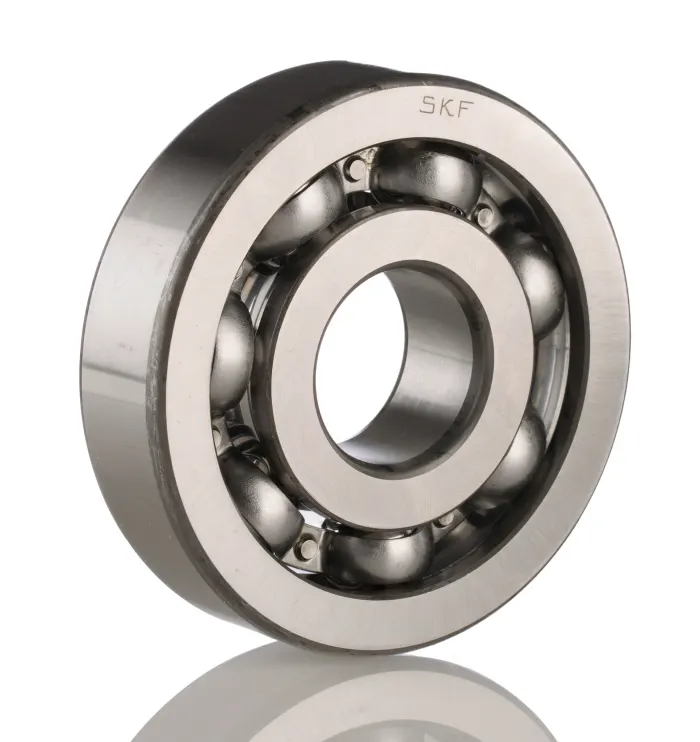
The short answer
Take 6205-2RS C3 as an example:
- 6: the bearing type, a deep groove ball bearing.
- 2: the dimension series, here the "02" light series.
- 05: the bore code. Multiply by 5 to get the bore: 05 × 5 = 25 mm.
- 2RS: rubber seals on both sides.
- C3: internal clearance greater than normal.
So a 6205-2RS C3 is a 25 mm bore deep groove ball bearing, sealed both sides, with C3 clearance. Its outside diameter is 52 mm and its width 15 mm. The core number (6205) is standardised, so a 6205 from SKF, NTN, FAG or NBC has the same dimensions. The suffixes (2RS and so on) vary between makers, as explained below.
The basic number: type, series and bore
The first digit or letters: bearing type
| Starts with | Bearing type | Example |
|---|---|---|
| 6 | Deep groove ball bearing (the most common bearing) | 6205 |
| 7 | Angular contact ball bearing | 7206 |
| 1 | Self-aligning ball bearing | 1206 |
| 2 | Spherical roller bearing (22, 23 series) | 22210 |
| 3 | Tapered roller bearing (30, 32, 33 series) | 30205 |
| 5 | Thrust ball bearing | 51105 |
| N, NU, NJ, NUP | Cylindrical roller bearing (letters show which rings have ribs) | NU 206 |
| UC, UCP, UCF | Insert bearing and bearing units (pillow block, flange) | UCP 205 |
The middle digit(s): dimension series
For the same bore, bearings come in several weights. In deep groove ball bearings, the 60 series is extra light, 62 light and 63 medium (64, heavy, is rarely used). A heavier series has a larger outside diameter and width and carries more load. That is why a 6005, a 6205 and a 6305 all have a 25 mm bore but different outside sizes.
Thin-section bearings in the 618 and 619 series (for example 61805, 61905) have the same bore again but much smaller outside diameters.
The last two digits: bore code
| Bore code | Bore |
|---|---|
| 00 | 10 mm |
| 01 | 12 mm |
| 02 | 15 mm |
| 03 | 17 mm |
| 04 and above | code × 5 (04 = 20 mm, 05 = 25 mm, 10 = 50 mm, 20 = 100 mm) |
Small bearings under 10 mm bore use the bore itself as the last digit: a 608 has an 8 mm bore (it is the common skateboard and small-machine bearing, 8 × 22 × 7 mm).
Suffixes: shields, seals and clearance
Shields and seals
The letters after the number say how the bearing is closed. These differ by maker, which causes most mix-ups:
| Meaning | Common markings |
|---|---|
| Open (no shields or seals) | No suffix |
| Metal shield, one side | Z |
| Metal shields, both sides | ZZ, 2Z |
| Rubber contact seal, one side | RS, RS1 (SKF), LU (NTN), DU (NSK) |
| Rubber contact seals, both sides | 2RS, 2RS1 or 2RSH (SKF), LLU (NTN), DDU (NSK) |
| Low-friction (non-contact) seals, both sides | 2RZ (SKF), LLB (NTN), VV (NSK) |
Shielded bearings (ZZ) keep out larger dirt with very little friction, so they suit higher speeds in fairly clean places. Sealed bearings (2RS) rub lightly on the inner ring and keep out fine dust and splashes far better, at the cost of a little more friction and a lower speed limit. Both are packed with grease for life and need no further lubrication. For dusty or wet conditions, choose 2RS.
Internal clearance
Internal clearance is the small amount the rings can move relative to each other. Normal clearance (CN) is not marked. C3 means more clearance than normal, and C4 more again. C3 is common on electric motors and on bearings that run hot or are fitted tightly on the shaft, because heat and an interference fit both take up clearance. If the old bearing was C3, replace it with C3.
Other suffixes you may meet
- N: a snap ring groove in the outer ring. NR: the groove with the snap ring fitted.
- K: a tapered bore (1:12 taper), for mounting on an adapter sleeve, common on self-aligning and spherical roller bearings.
- M: a machined brass cage. TN9 (SKF): a glass-fibre reinforced polyamide cage. J: a pressed steel cage.
- P6, P5: higher precision classes than normal, for machine tool spindles and similar.
- E on many SKF and FAG roller bearings: a later, higher-capacity internal design. It fits the same housing and shaft.
Deep groove ball bearing size chart
Dimensions in millimetres: bore × outside diameter × width. These are standard (ISO 15), so they apply to every brand.
| Bore | 60 series | 62 series | 63 series |
|---|---|---|---|
| 10 | 6000: 10 × 26 × 8 | 6200: 10 × 30 × 9 | 6300: 10 × 35 × 11 |
| 12 | 6001: 12 × 28 × 8 | 6201: 12 × 32 × 10 | 6301: 12 × 37 × 12 |
| 15 | 6002: 15 × 32 × 9 | 6202: 15 × 35 × 11 | 6302: 15 × 42 × 13 |
| 17 | 6003: 17 × 35 × 10 | 6203: 17 × 40 × 12 | 6303: 17 × 47 × 14 |
| 20 | 6004: 20 × 42 × 12 | 6204: 20 × 47 × 14 | 6304: 20 × 52 × 15 |
| 25 | 6005: 25 × 47 × 12 | 6205: 25 × 52 × 15 | 6305: 25 × 62 × 17 |
| 30 | 6006: 30 × 55 × 13 | 6206: 30 × 62 × 16 | 6306: 30 × 72 × 19 |
| 35 | 6007: 35 × 62 × 14 | 6207: 35 × 72 × 17 | 6307: 35 × 80 × 21 |
| 40 | 6008: 40 × 68 × 15 | 6208: 40 × 80 × 18 | 6308: 40 × 90 × 23 |
| 45 | 6009: 45 × 75 × 16 | 6209: 45 × 85 × 19 | 6309: 45 × 100 × 25 |
| 50 | 6010: 50 × 80 × 16 | 6210: 50 × 90 × 20 | 6310: 50 × 110 × 27 |
Reading other common bearing numbers
22210 E: spherical roller bearing (2), 22 series, bore 10 × 5 = 50 mm, E design.30205: tapered roller bearing, 302 series, 25 mm bore. Tapered roller bearings come as a cone (inner ring with rollers) and a cup (outer ring), and are usually fitted in pairs.NU 206: cylindrical roller bearing with ribs on the outer ring only, 30 mm bore. The inner ring can slide, so it takes no axial load.UCP 205: a pillow block unit, with a UC 205 insert bearing (25 mm bore) in a P 205 cast iron housing. UCF is a four-bolt flange unit and UCFL a two-bolt flange unit.7206 B: single row angular contact ball bearing, 30 mm bore, 40° contact angle (B). Usually fitted in pairs.
Is a bearing from one brand the same as another?
The base number and dimensions are international: a 6205 from any maker has a 25 mm bore, 52 mm outside diameter and 15 mm width, and fits the same shaft and housing. What differs is the suffix code for seals, cages and clearance, as the table above shows, and the quality of the steel, finishing and seals. When you change brands, match the type of closure and clearance, not just the letters.
Watch out for fakes. Counterfeit bearings with famous brand names are common and fail early. Buy from an authorised dealer, and be suspicious of prices far below the market. Kutbi Chain Centre is an SKF dealer and supplies genuine branded bearings.
How to identify a bearing with no visible number
- Clean the side faces. The number is usually etched or stamped on the outer ring face or the shield, and may still be readable after cleaning.
- Measure the bore, outside diameter and width with a vernier caliper, to the nearest 0.1 mm. Inch-size bearings will not match the metric chart; tell us if the machine is imported.
- Note the type. Balls or rollers? One row or two? Does it have shields, seals or neither? Is there a groove round the outer ring?
- Send us the three dimensions and a photo. In most cases that is enough to name the bearing.
Why bearings fail early
- Poor fitting: hammering on the outer ring when pressing onto a shaft dents the raceways. Press only on the ring being fitted.
- Contamination: dust and water entering an open or shielded bearing.
- Wrong lubrication: too little grease, too much grease (which churns and overheats), or mixing incompatible greases.
- Misalignment between shaft and housing, which loads the balls unevenly.
- Overload or the wrong bearing type for the load, for example a deep groove ball bearing carrying a heavy axial load.
What to send us when you order
- The full number from the old bearing, including all letters, for example
6205-2RS1/C3. - Or the bore, outside diameter and width, and whether it is open, shielded or sealed.
- The brand you prefer (SKF, FAG, NTN, NBC and others), and the quantity.
We stock SKF, FAG, NTN and NBC bearings, bearing units and plummer blocks at our shop on SP Road, Bengaluru.